This was a brilliant conclusion to the trilogy. I can only compare it
to "Ender's Game" - and that is extremely high praise, indeed.
When I first closed the book last night, I felt shattered, empty, and drained.
And that was the point, I think. I'm glad I waited to review the book because I'm not sure what my review would have been.
When I first closed the book last night, I felt shattered, empty, and drained.
And that was the point, I think. I'm glad I waited to review the book because I'm not sure what my review would have been.
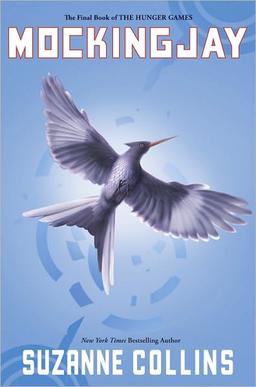
For
the first two books, I think most of us readers have all been laboring
under the assumption that Katniss Everdeen would eventually choose one
of the two terrific men in her life: Gale, her childhood companion or
Peeta, the one who accompanied her to the Hunger Games twice. She'd
pick one of them and live happily ever after with him, surrounded by
friends and family. Somehow, along the way, Katniss would get rid of
the awful President Snow and stop the evil Hunger Games. How one
teenage girl would do all that, we weren't too sure, but we all had
faith and hope that she would.
"Mockingjay" relentlessly strips aside those feelings of faith and hope - much as District 13 must have done to Katniss. Katniss realizes that she is just as much a pawn for District 13 as she ever was for the Colony and that evil can exist in places outside of the Colony.
And that's when the reader realizes that this will be a very different journey. And that maybe the first two books were a setup for a very different ride. That, at its heart, this wasn't a story about Katniss making her romantic decisions set against a backdrop of war.
This is a story of war. And what it means to be a volunteer and yet still be a pawn. We have an entirely volunteer military now that is spread entirely too thin for the tasks we ask of it. The burden we place upon it is great. And at the end of the day, when the personal war is over for each of them, each is left alone to pick up the pieces as best he/she can.
For some, like Peeta, it means hanging onto the back of a chair until the voices in his head stop and he's safe to be around again. Each copes in the best way he can. We ask - no, demand - incredible things of our men and women in arms, and then relegate them to the sidelines afterwards because we don't want to be reminded of the things they did in battle. What do you do with people who are trained to kill when they come back home? And what if there's no real home to come back to - if, heaven forbid, the war is fought in your own home? We need our soldiers when we need them, but they make us uncomfortable when the fighting stops.
All of that is bigger than a love story - than Peeta or Gale. And yet, Katniss' war does come to an end. And she does have to pick up the pieces of her life and figure out where to go at the end. So she does make a choice. But compared to the tragedy of everything that comes before it, it doesn't seem "enough". And I think that's the point. That once you've been to hell and lost so much, your life will never be the same. Katniss will never be the same. For a large part of this book, we see Katniss acting in a way that we can only see as being combat-stress or PTSD-related - running and hiding in closets. This isn't our Katniss, this isn't our warrior girl.
But this is what makes it so much more realistic, I think. Some may see this as a failing in plot - that Katniss is suddenly acting out of character. But as someone who has been around very strong soldiers returning home from deployments, this story, more than the other two, made Katniss come alive for me in a much more believable way.
I realize many out there will hate the epilogue and find it trite. At first, I did too. But in retrospect, it really was perfect. Katniss gave her life already - back when she volunteered for Prim in "The Hunger Games". It's just that she actually physically kept living.
The HBO miniseries, "Band of Brothers", has a quote that sums this up perfectly. When Captain Spiers says, "The only hope you have is to accept the fact that you're already dead. The sooner you accept that, the sooner you'll be able to function as a soldier is supposed to function: without mercy, without compassion, without remorse. All war depends upon it."
But how do you go from that, to living again in society? You really don't. So I'm not sure Katniss ever really did - live again. She just ... kept going. And there's not really much to celebrate in that. Seeing someone keep going, despite being asked - no, demanded - to do unconscionably horrifying things, and then being relegated to the fringes of society, and then to keep going - to pick up the pieces and keep on going, there is something fine and admirable and infinitely sad and pure and noble about that. But the fact is, it should never happen in the first place.
And that was the point, I think.
"Mockingjay" relentlessly strips aside those feelings of faith and hope - much as District 13 must have done to Katniss. Katniss realizes that she is just as much a pawn for District 13 as she ever was for the Colony and that evil can exist in places outside of the Colony.
And that's when the reader realizes that this will be a very different journey. And that maybe the first two books were a setup for a very different ride. That, at its heart, this wasn't a story about Katniss making her romantic decisions set against a backdrop of war.
This is a story of war. And what it means to be a volunteer and yet still be a pawn. We have an entirely volunteer military now that is spread entirely too thin for the tasks we ask of it. The burden we place upon it is great. And at the end of the day, when the personal war is over for each of them, each is left alone to pick up the pieces as best he/she can.
For some, like Peeta, it means hanging onto the back of a chair until the voices in his head stop and he's safe to be around again. Each copes in the best way he can. We ask - no, demand - incredible things of our men and women in arms, and then relegate them to the sidelines afterwards because we don't want to be reminded of the things they did in battle. What do you do with people who are trained to kill when they come back home? And what if there's no real home to come back to - if, heaven forbid, the war is fought in your own home? We need our soldiers when we need them, but they make us uncomfortable when the fighting stops.
All of that is bigger than a love story - than Peeta or Gale. And yet, Katniss' war does come to an end. And she does have to pick up the pieces of her life and figure out where to go at the end. So she does make a choice. But compared to the tragedy of everything that comes before it, it doesn't seem "enough". And I think that's the point. That once you've been to hell and lost so much, your life will never be the same. Katniss will never be the same. For a large part of this book, we see Katniss acting in a way that we can only see as being combat-stress or PTSD-related - running and hiding in closets. This isn't our Katniss, this isn't our warrior girl.
But this is what makes it so much more realistic, I think. Some may see this as a failing in plot - that Katniss is suddenly acting out of character. But as someone who has been around very strong soldiers returning home from deployments, this story, more than the other two, made Katniss come alive for me in a much more believable way.
I realize many out there will hate the epilogue and find it trite. At first, I did too. But in retrospect, it really was perfect. Katniss gave her life already - back when she volunteered for Prim in "The Hunger Games". It's just that she actually physically kept living.
The HBO miniseries, "Band of Brothers", has a quote that sums this up perfectly. When Captain Spiers says, "The only hope you have is to accept the fact that you're already dead. The sooner you accept that, the sooner you'll be able to function as a soldier is supposed to function: without mercy, without compassion, without remorse. All war depends upon it."
But how do you go from that, to living again in society? You really don't. So I'm not sure Katniss ever really did - live again. She just ... kept going. And there's not really much to celebrate in that. Seeing someone keep going, despite being asked - no, demanded - to do unconscionably horrifying things, and then being relegated to the fringes of society, and then to keep going - to pick up the pieces and keep on going, there is something fine and admirable and infinitely sad and pure and noble about that. But the fact is, it should never happen in the first place.
And that was the point, I think.
By the end of the book I realized how true and how perfect the ending
was. This book series was never a "fairytale" story. In war things don't
end with sunshine and butterflies. They end with broken people trying
to pick up the pieces of there life and put them back together the best
way they can. That is the most heroic effort of all. Not killing
President Snow, not defeating an entire army all by yourself. No, a true
hero is someone who has been through hell and decides to still try to
move forward despite the pain and difficulty of each day. Kudos to
Suzanne Collins for giving a generation of people far detached from real
war, the chance to realize that it isn't glorious or rewarding. It's
heartbreaking and you are never the same.

